
Published: February 8, 2026 · Updated: June 2, 2026 · 11 min read
When travelers come to Morocco, they often ask about "the Berbers" — a word they have heard but know little about. Understanding the Amazigh people (the correct name for themselves — "Amazigh" means "free people" in the Tamazight language) is key to appreciating Morocco deeply. Far from being a historic or marginal group, the Amazigh are the original and still numerically majority indigenous people of North Africa. Their history predates the Arab conquest by thousands of years, their culture is deeply woven into everything from the architecture to the food to the music, and in the desert regions of Morocco, their living traditions remain vivid and immediate.
Who Are the Amazigh People?
The Amazigh are the indigenous people of North Africa, with a continuous presence in the region dating back at least 10,000 years — long before the Phoenicians, Romans, Arabs, or any other historical civilization arrived. Their ancestral territory, which they call Tamazgha, stretches from the Atlantic coast of Morocco and the Canary Islands in the west, across Algeria and Tunisia, to Libya and Egypt in the east, and south across the Sahara to the Tuareg territories of Mali, Niger, and Burkina Faso.
In Morocco, Amazigh people make up an estimated 40–60% of the population (statistics vary depending on definition and methodology). They are concentrated in the Atlas Mountains (where they are called the Imazighen or Berbers of the High and Middle Atlas), the Rif Mountains in the north (the Rifians), and the pre-Saharan and Saharan south (the Shluh or Chleuh of the Anti-Atlas and the nomadic desert communities). Millions more Amazigh people live in the cities, where they often speak Darija (Moroccan Arabic) alongside Tamazight.
The Tamazight Language
Tamazight (sometimes written Tifinagh in its ancient script, which is still used for decoration and in schools) is the Amazigh language — one of the oldest continuously spoken languages in the world, with a history of over 3,000 years. It has several regional dialects in Morocco: Tachelhit (or Chleuh) in the south and Anti-Atlas; Tamazight of the Middle Atlas; and Tarifit in the Rif. Despite centuries of Arabization — and French colonialism — Tamazight is very much alive and is now recognized as an official language of Morocco alongside Arabic.
Learning a few words of Amazigh is genuinely appreciated in the desert regions. Some basics: Azul (hello), Tanmirt (thank you), Mamnoun (pleased to meet you), Amdigh (I'm happy / good). Your guide can teach you more.
Amazigh Architecture: The Ksar and Kasbah
The most visible expression of Amazigh culture on a Morocco tour is the architecture. The ksar (plural: ksour) is the Amazigh fortified village — a self-contained community built from pisé (rammed earth), typically with a single entrance, thick defensive walls, a central communal space, and individual family homes stacked above each other up the hillside. Aït Benhaddou, the most famous ksar in Morocco and a UNESCO World Heritage Site, is a perfect example — and every desert tour passes through it.
The kasbah is the fortified residence of a powerful family or chief — larger, more elaborate, and more decorated than the communal ksar. The valley of the Drâa, Dades, and Todra is lined with hundreds of kasbahs in varying states of preservation, each one a testimony to the Amazigh tradition of building permanence and beauty out of the most basic material: earth.
Music: Gnawa, Ahwach, and the Bendir Drum
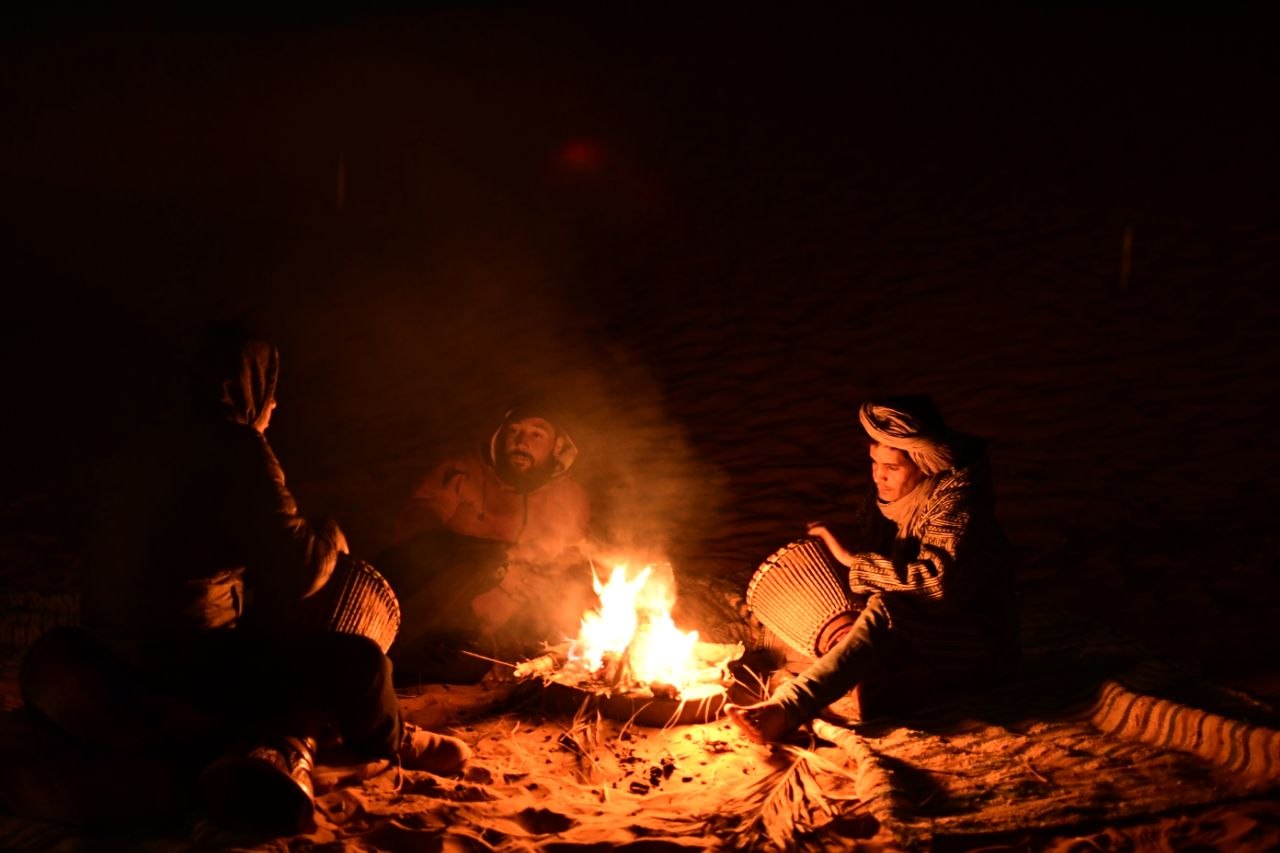
The music you will hear around the campfire in the desert — and at many cultural events in the south — is rooted in Amazigh and Gnawa traditions. The bendir (large frame drum), tbel (double-headed drum), and the haunting ginbri (three-stringed bass lute) are the instruments of traditional desert music. Gnawa music is a distinct tradition brought to Morocco by enslaved sub-Saharan Africans and syncretized with Amazigh and Islamic musical forms — its hypnotic, repetitive rhythms and call-and-response vocals were originally used in healing ceremonies but are now performed widely for cultural and artistic appreciation.
The Ahwach is the traditional collective music and dance of the southern Amazigh — a large ensemble of musicians and dancers moving in a circle, with antiphonal singing between male and female choruses, accompanied by bendir drumming. If you happen upon an Ahwach performance during your tour, consider yourself very fortunate — it is one of the most spectacular living cultural traditions in Morocco.
Food: Tagine, Couscous, and the Importance of Hospitality
Much of what Morocco is famous for culinarily — the tagine, couscous, harira, msemen, argan oil, saffron — has roots in or was shaped by Amazigh food culture. The concept of hospitality (tighri in Tamazight) is central to Amazigh identity — the obligation to welcome and feed any traveler is not just a custom but a deeply held value. When you are offered mint tea in a Berber home or at a desert camp, it is a genuine expression of this hospitality, not merely a commercial transaction.
Argan oil — one of the world's most prized culinary and cosmetic oils, made from the fruit of the argan tree native to southern Morocco — is a distinctly Amazigh product. The cooperative tradition of argan oil production, traditionally done by women's cooperatives in the Souss-Massa region, has been an important economic and cultural institution for centuries. If you buy argan oil during your tour, look for products made by genuine women's cooperatives — your guide will know the reliable sources.
How to Be a Respectful Visitor
- Ask before photographing people. In many Amazigh communities, particularly older women and children, people are sensitive about having their photographs taken by strangers. Always ask your guide how to approach this in each specific location.
- Learn a few words of Tamazight or Darija. Even the simplest greeting (Azul — hello) is received with genuine warmth and demonstrates respect for the local culture.
- Buy crafts at source. The rugs, silver jewelry, argan oil, and pottery sold in Amazigh villages are often made by the same families who sell them. Buying directly, even at a negotiated price, supports the community far more than buying in city shops.
- Dress modestly in villages. Outside resort areas, covered shoulders and knees are expected and respected. Your guide will advise on local norms.
- Accept hospitality graciously. If you are invited for tea, accept — declining is considered rude. Tea is never compulsory to follow with a purchase.
- Remember the name. They are Amazigh, not "Berbers" — the latter is a Latinization derived from "barbarian" imposed by outsiders. Using the correct term is appreciated.
One of the great privileges of our desert tours is that they take you through genuine Amazigh communities — not staged cultural shows but real villages where real people live by traditions stretching back millennia. Our local guides are themselves Amazigh, and their knowledge and love for their culture adds immeasurably to the experience.